Brow Lamination vs Brow Rehab - What's Right for Your Brows
I get asked about brow lamination constantly - and I love the question, because it tells me the person asking is thinking carefully about their brows rather than just booking the most popular treatment.
But there is a second question that comes up almost as often, and it is one I think deserves its own answer: what do you do if your brows have been through years of over-tweezing, tinting or treatments that have left them sparse, patchy or growing in the wrong direction? Can lamination help? Or does something else need to happen first?
The honest answer is that it depends on the brow in front of me. And the only way to know for certain is to look at it properly before deciding anything.
What Brow Lamination Actually Does
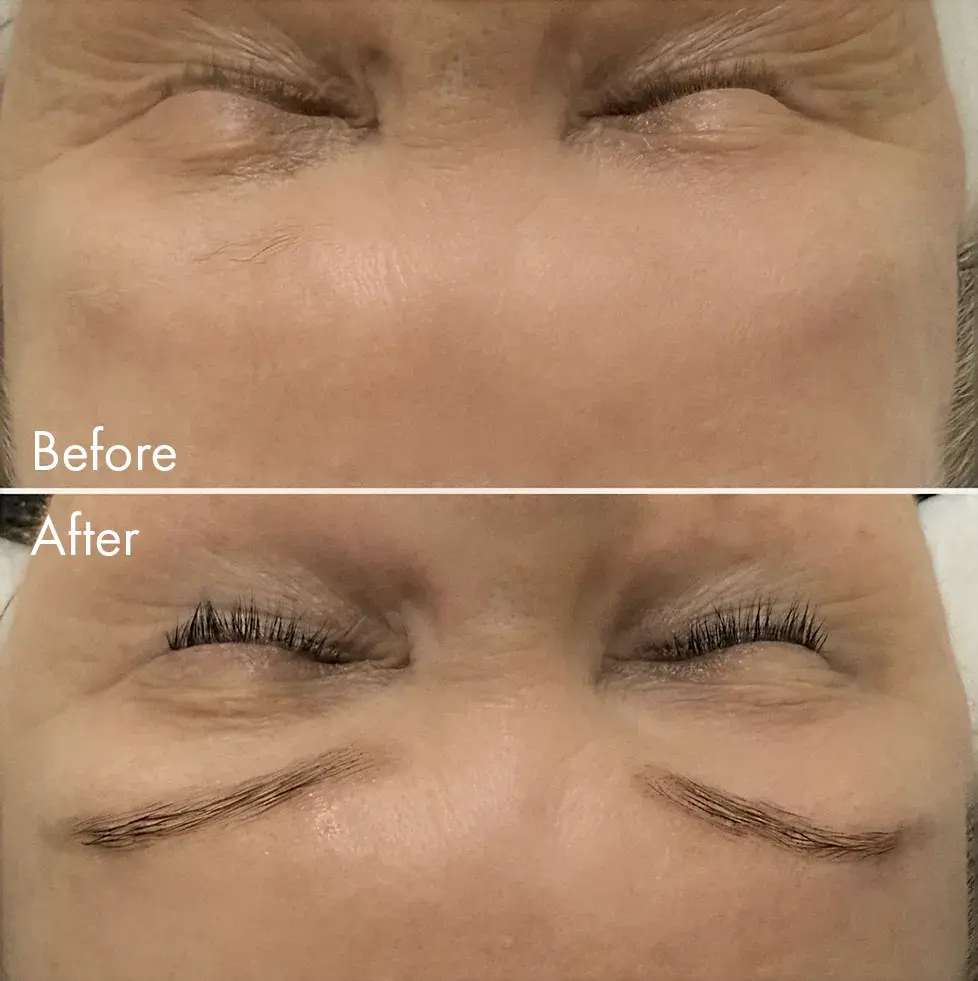
Brow lamination is a semi-permanent treatment that restructures the brow hairs into a set direction - typically lifted and brushed upward - using a two-step chemical process. The first solution breaks down the bond within the hair structure. The second sets the hair in its new position. A keratin formula conditions the hair as it works, which leaves brows looking fuller and softer rather than stiff or over-processed.
The result is brows that hold their shape for six to eight weeks without daily styling. For clients with flat, unruly, or downward-growing hairs, the transformation can be significant. Hairs that previously lay flat or grew in scattered directions sit upward and uniform, creating the appearance of much fuller brows.
What lamination cannot do is create hairs that are not there. It works with what you have. If your brows are genuinely sparse - significant gaps, thinning from the tail end, or follicles that have been dormant for years - lamination will improve what is there but will not fill what is missing. Have a look at our brow lamination for thin brows page.
Full detail on the treatment, including what happens at your appointment and pricing, is on our brow lamination Auckland page.
What Brow Rehab Means
Brow rehab is not a single treatment. It is an approach - a considered plan for returning brows to their healthiest state when they have been over-treated, over-tweezed, or are simply not growing as they should.
In practice, brow rehab at En Beauty typically involves three things: an honest assessment of the current state of the brows, a period of rest where nothing further is removed or chemically treated, and a combination of supportive treatments and products that encourage the natural growth cycle to do its work.
The most important and least glamorous part of brow rehab is the rest period. Growing brows back requires patience. The natural hair cycle takes six to eight weeks for a lash or brow hair to complete - which means that if follicles have been dormant for months or years, results take time to appear. There is no treatment that accelerates a hair follicle that has decided to slow down.
What can support the process: a brow serum applied consistently to the brow root each evening, a gentle approach to any remaining treatments, and an honest conversation about realistic timelines.
Who Needs Lamination and Who Needs Rehab
This is the question I am actually answering when a client sits down for their consultation. These are the signals I look for:
Lamination is likely the right choice if:
Your brows have good density - enough hairs, just unruly, flat or growing in different directions
The tail of the brow is present - the outer third has hairs even if they are sparse
Your brows have not been significantly over-tweezed - they have been maintained but not stripped
You want more volume and definition from what you already have
You are not in the middle of a growth phase - the hairs are established and settled
Rehab - or a modified approach - is likely right if:
There are genuine gaps in the brow where hairs are simply absent
The brow tail is missing or very thin - the outer corner has been over-tweezed over many years
Your brows are visibly different from each other in density or shape as a result of repeated treatment
Your brow hairs feel brittle or break easily - a sign of over-processing from repeated chemical treatments
You have recently had a period of significant hair loss - post-pregnancy, illness, medication
Your brow colour is faded or too fine and thin to tint
The important nuance is that rehab and lamination are not mutually exclusive. For many clients, a gentle lamination applied carefully to hairs that are present can be part of a rehabilitation approach - making existing hairs look their best while the growth period continues. The difference is in how aggressively the treatment is applied and what the realistic expectation is for the result.
Over-Tweezed Brows - What Recovery Actually Looks Like
Over-tweezed brows are one of the most common things I see at En Beauty. Clients who grew up in the 1990s and early 2000s, when very thin brows were the prevailing fashion, often come to me with significantly diminished natural brow density. The follicles that were repeatedly removed over many years have in some cases stopped regenerating.
The honest answer about recovery is that it is partial for most people. Follicles that have been dormant for a long time can sometimes be reactivated with consistent brow serum use and a rest period - but some follicles have been permanently affected by years of removal. A realistic outcome is improved growth from follicles that are still active, but not necessarily a return to the density of un-tweezed brows.
This is a conversation I have with clients at consultation, because it affects what treatment I recommend and what result I can honestly promise. Brow lamination on genuinely sparse brows will improve their appearance and make the most of what is there. It will not, on its own, produce brows that are not there.
What I tend to recommend for clients in this situation: a rest period of at least six to eight weeks with daily brow serum, a gentle lamination to improve the hairs that are present, and an honest assessment of whether the result is heading in the right direction after three to four months of consistent care.

The Tinting and Shaping Philosophy
Tinting and shaping are often the most underestimated parts of a brow treatment. A well-executed tint adds depth and the appearance of density that even a good lamination cannot achieve alone. For clients with very light or greying brows, tinting is often the single highest-impact intervention.
Shaping is where the technical precision matters most. The mapping of a brow shape - the arch placement, the tail length, the relationship between the brow and the bone structure beneath it - is where results that genuinely suit a face are made or missed. At En Beauty, no shaping begins without mapping. The brow is measured and marked before anything is removed.
For clients in a rehab phase, I tend to be conservative with shaping. The goal is to remove as little as possible while creating the impression of a clean, defined shape. Every hair that stays is a hair contributing to density.
See the full range of brow treatments and pricing on our brow treatments North Shore page.
Realistic Timelines
I would rather give an honest timeline than a hopeful one.
For clients starting brow lamination on brows with good existing density: the result is visible immediately and lasts six to eight weeks. Most clients book every six to seven weeks to maintain the result.
For clients beginning a rehab period: three to four months is the minimum timeline before a realistic assessment can be made. Some clients see meaningful improvement within eight weeks. Others take longer. The variable is the individual follicle, not the treatment.
For clients whose brow gaps are significant and stable - where the follicles appear to have stopped regenerating - the conversation eventually moves to whether a more permanent solution is worth considering. That is a separate decision and not one I rush. There is always more to do with careful lamination, tinting and shaping before reaching that point.

A Note on Products Between Appointments
The product I recommend most consistently for clients in a brow rehab phase is a brow serum applied to the root each evening. Applied consistently over six to eight weeks, most clients notice their natural brow hairs feeling stronger and less prone to breakage. Some notice increased growth from follicles that had slowed down.
Beyond serum, the most useful thing a client can do is simply leave their brows alone between appointments. No tweezing between visits. No at-home tinting. No threading by someone who has not been briefed on the growth plan. The rest period is as important as any treatment.
If you are also considering lash treatments while working on your brows, read about our approach to lash health at every appointment - the same principle applies.
Considering your first brow appointment and not sure where to start? Read about what to expect at a first lash and brow consultation at En Beauty.
Booking
En Beauty is in Northcote on Auckland's North Shore, with free parking directly outside. If you are not sure whether lamination or a rehab approach is right for your brows, the consultation at your first appointment is where we work that out together. View our full brow lamination page or book directly below.


The article is written competently and offers reliable information. I found a lot of useful information that I did not know before. I pointed this text out to a colleague who was looking for similar information. It is a balanced article that addresses the topic in a complete way.
This text covers the topic in a comprehensive and precise way. I appreciated the consistency of tone maintained throughout the text. I appreciated being able to find all this information in one place. It is hard to find texts that explain this topic with such clarity.
The structure of the article is very well thought out and easy to follow. I found the section dedicated to the practical details particularly useful. I found this article right when I needed it. It is content that is read willingly thanks to the clarity of the writing.
This article provides an insightful exploration into brow treatments, particularly the nuances of brow lamination and rehab. It's clear that brow lamination can enhance existing hairs but can’t create new ones. For those with severely sparse brows, understanding that they may need a comprehensive brow rehab approach is crucial. Balancing treatments like brow lamination and rehab is key to achieving the best results. Vegas Now might see similar trends in the beauty industry, where thorough assessments are crucial for effective treatments.
The article sheds light on the often-overlooked aspect of vehicle maintenance that is critical for safety. It emphasizes factors like tire longevity and fuel efficiency tied to proper alignment, which are akin to finding a Kiwi Treasure in vehicle upkeep. Ignoring these insights can lead to costly repairs and dangerous situations on the road. Understanding these dynamics is imperative for any driver.